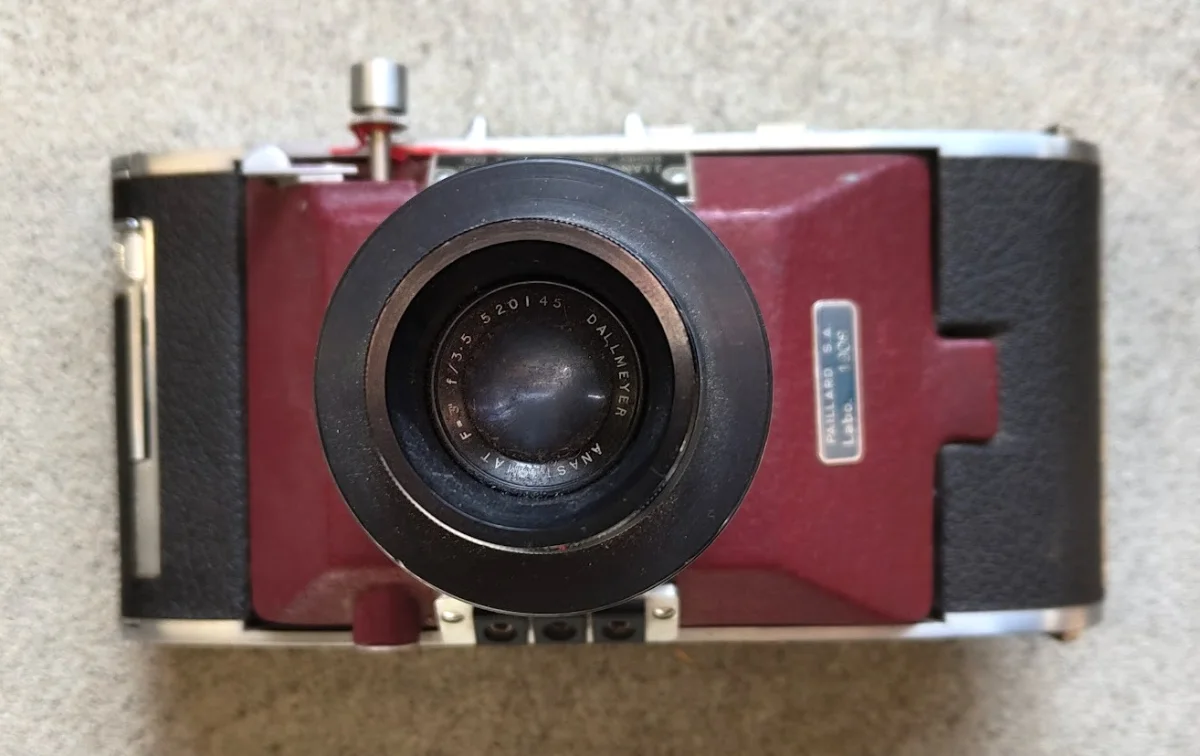
Thompson Land Camera — Oscilloscope Recording Camera by J. Langham Thompson, Bushey Heath (ca. 1955–62) — ex Paillard SA Laboratory, Sainte-Croix
CHF 430.00
The Thompson Land Camera was developed by J. Langham Thompson Ltd. of Bushey Heath, Hertfordshire, England, for the photographic recording of cathode-ray-tube traces on oscilloscopes and the display faces of other laboratory instruments. Before digital storage oscilloscopes made the practice obsolete, this was the standard method for preserving a transient electrical waveform: the camera was bolted directly to the CRT housing, the operator fired the shutter, and a Polaroid pack-film print delivered a hard copy in seconds. Thompson cameras of this type were used in research institutions, universities, and industrial laboratories across Britain and Europe throughout the late 1950s and into the 1960s.
This example — Serial Nº 400/225, as stamped on the maker's plaque — is built around an adapted Polaroid Land Camera back (Polaroid Corporation, Cambridge, Mass., USA; Patent Nos. 2,435,717 / 2,435,720 / 2,455,111 / D-152,229 / 2,504,312 / 2,531,936 / 2,538,511 / 2,543,159 and others). The inner film-plane door and rollers are intact and legible. The body shell is the distinctive crimson-red cast aluminium form, accented by a chromed perimeter frame and finished with black leatherette on the sides. The optical system is a Dallmeyer (Oscillograph) Anastigmat F = 3″ / 1:3.5, serial 520145, mounted in a long black-anodised helical focusing tube that screws directly into the body. A central leaf shutter — likely of Gauthier lineage — provides B, C, and M settings, accessed via three coaxial flash sockets on the side panel. The synch panel also carries a cable-release socket and a secondary locking wheel. A standard ¼″ tripod bush is present on the base.
Provenance is documented by two labels: the maker's engraved metal plaque on the top deck reading "THOMPSON LAND CAMERA / Serial Nº 400/225 / J. LANGHAM THOMPSON LTD. / BUSHEY HEATH. HERTS. ENG.", and a small blue Paillard SA laboratory inventory plate — "PAILLARD S.A. / Labo. 1808" — affixed to the front face. Paillard SA, headquartered at Sainte-Croix in the canton of Vaud, was one of Switzerland's most celebrated precision-engineering firms; their research laboratories would have used an oscilloscope camera of this type for electronics development and quality testing related to Bolex motors, Hermes mechanisms, and Thorens drive systems.
Film compatible with this back is long discontinued and the camera is offered as a museum-quality historical artefact and display piece rather than an operational photographic instrument. That said, the mechanical and optical elements remain substantially intact and the piece merits conservation rather than any further use.
Material: Cast aluminium body shell finished in crimson-red enamel; chromed steel frame and fittings; black leatherette covering; black-anodised helical lens tube; Polaroid roll-film back in black-painted pressed steel
Condition notes
The body shell is solid throughout, with the crimson-red enamel showing honest age-related scuffs and light surface marks consistent with decades of laboratory service — notably on the underside and around the lens housing — but no cracks or structural damage. The chromed frame retains good lustre with minor oxidation at edges. Both engraved plaques (maker's and Paillard SA inventory) are fully legible. The black leatherette covering is complete and adhered. The Dallmeyer lens glass appears clear with light cleaning marks visible under oblique light; the iris operates smoothly. The helical focusing tube advances and retracts without binding. The central leaf shutter fires on visual inspection; the B/C/M synch sockets and cable-release are present and appear intact, though no electrical test has been performed. The Polaroid Land back is original to the camera; the interior film-plane door and rollers are present and legible, though roll film for this system has been commercially unavailable for decades. The camera is offered as a display and collection piece; operational use is not practicable with available film stocks.