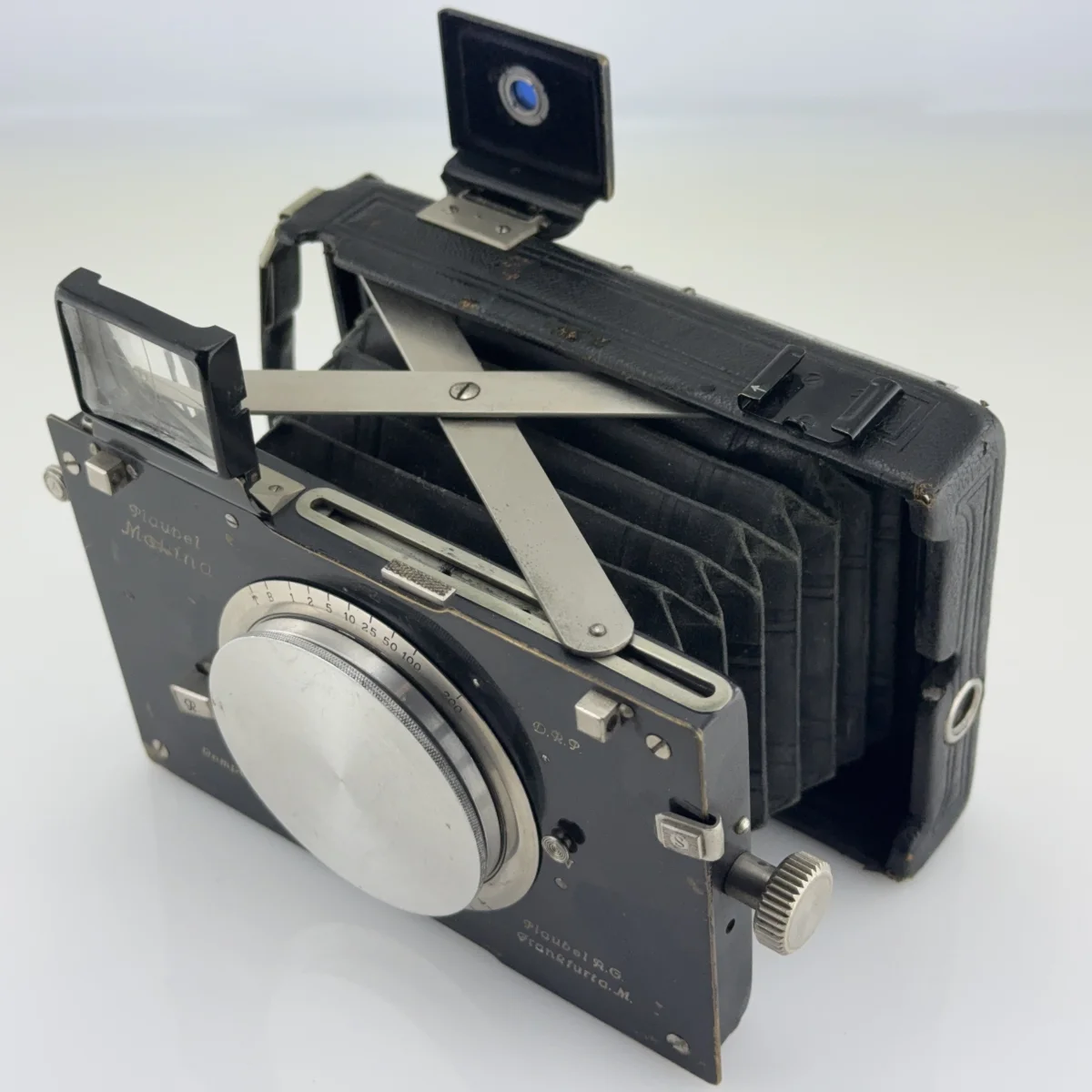
Plaubel Makina — Early Folding Press Camera with Anticomar 10cm f/2.9 & Compur Shutter, ca. 1930s
CHF 290.00
The camera is fitted with a Plaubel Anticomar 10 cm f/2.9 lens — an exceptionally fast optic for its format and period, designed in-house by Plaubel and highly regarded for its portraiture rendering. The lens seats in a Compur leaf shutter with speeds engraved T, B, 1, 2, 5, 10, 25, 50, 100, and 200, as clearly visible on the shutter speed ring in the images. The faceplate is engraved "Plaubel Makina," "D.R.P.," "Compur," and "Plaubel A.G. Frankfurt a. M." — a full complement of original manufacturer markings. A knurled focusing wheel is mounted on the right side of the front standard, driving a rack-and-pinion mechanism with a depth-of-field scale graduated in the range visible in the side view.
The viewfinder system is particularly complete: both the folding frame sportsfinder and the smaller optical brilliant finder are present and upright. The rear of the camera carries the embossed Plaubel circular logo on the leatherette back door. A removable depth-of-field reference card — engraved in German for the Anticomar f/2.9 10 cm lens across apertures f/2.9 through f/18 — is present and clipped to the camera body, a delightful period accessory that underscores the working-professional pedigree of the Makina system.
The bellows are black and appear intact without immediately visible pinholes, though light-tightness should be verified before any serious use. The leatherette covering shows general age-related wear including light scuffing and surface oxidation to the metal trim, consistent with honest working use over decades. The camera is configured for glass plate or sheet-film holders at the rear, and the film-plane back shows the typical Makina sliding holders in the top view.
Material: Black-lacquered die-cast metal body with leatherette covering, nickel-plated steel struts and hardware, black accordion bellows, chrome-finish lens barrel and Compur shutter housing
Condition notes
Overall condition grades VG (Very Good) for a camera of this age. The black lacquer on the metal front and rear standards shows expected wear with some light chipping and surface oxidation at corners and edges. Leatherette covering is largely intact but presents scuffing, minor creasing, and age-related surface degradation, most notably on the rear door and top surfaces. Nickel/chrome strut hardware retains its finish well with only minor tarnish. Both viewfinders (frame finder and brilliant finder) are present and functional in appearance. The Compur shutter face and lens barrel appear clean and undamaged; optical condition of the Anticomar elements cannot be fully confirmed from images alone — there is no visible obvious fungus or separation, but this requires hands-on inspection. The bellows appear structurally sound with no obvious tears visible, but light-seal integrity must be tested. The depth-of-field reference plate is present with some ink annotations (pen markings) on the table. The focusing wheel knob and rack assembly appear intact.