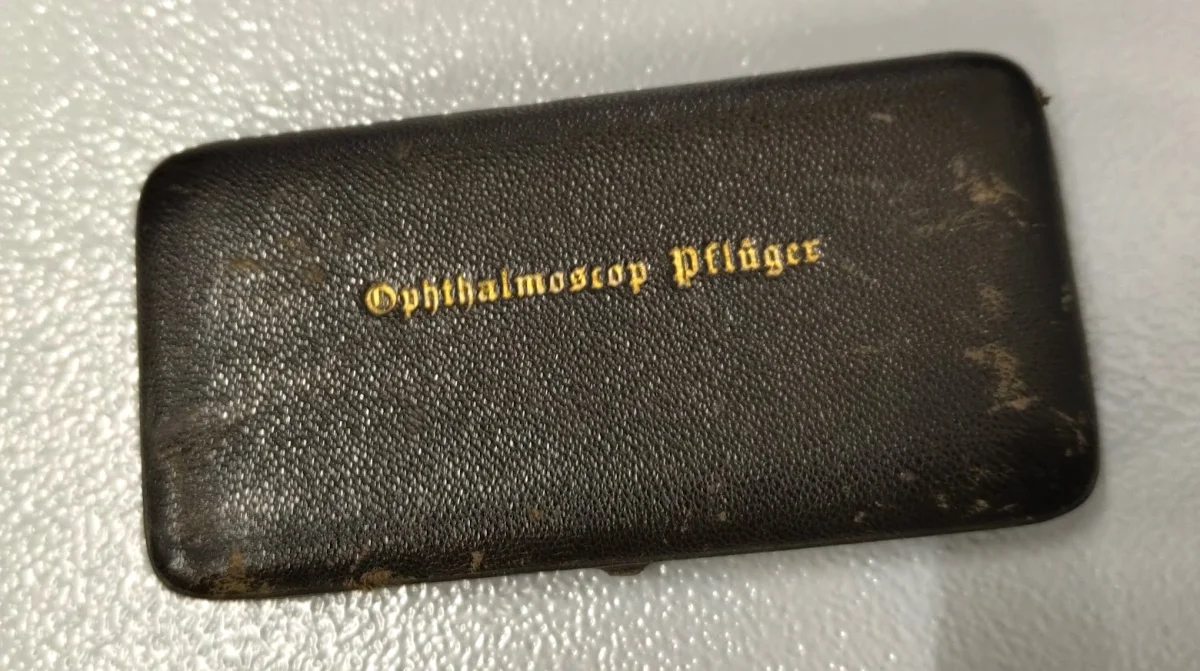
Pflüger Refraction Ophthalmoscope — Swiss, c. 1890–1905 — Complete in Original Leather Étui
CHF 1240.00
Ernst Pflüger (1846, Büren an der Aare – 1903, Bern) trained under Donders in Utrecht and von Arlt in Vienna before succeeding Henri Dor at Bern in 1876. Beyond his celebrated colour-vision plates and E-hook optotypes, he made substantial contributions to refractive diagnostics and direct ophthalmoscopy; the refraction ophthalmoscope offered here is named explicitly as one of his three principal instrumental contributions in the standard reference biography (Historisches Lexikon der Schweiz, art. 14582).
The set comprises:
Refraction ophthalmoscope head in black-japanned finish with rotating Rekoss-style correction-lens disc and brass index lever (dioptric scale visible, including the +3 sphere position)
Detachable handle stub in brass
Separate auxiliary concave mirror in brass mount, for retinoscopy / skiascopy
Large biconvex condensing lens for indirect ophthalmoscopy
Ivory-handled brass fixation pointer
Removable astigmatism-axis indicator disc on elastic mount inside the lid, graduated 0°–90°–0° (TABO convention)
Construction is almost certainly by Pfister & Streit, Bern — the precision workshop that supplied the Inselspital eye clinic during Pflüger's directorship and that would later (1933) become Haag-Streit AG. No external maker's stamp is visible on the case itself; an internal maker's mark on the metalwork may be present.
Condition: well-preserved with honest age patina. Leather case shows rubbing to the high points and minor surface losses at the edges, gold Fraktur title clear and legible, hinge sound, snap closure functioning. Violet silk-velvet interior is bright and intact. Optical elements clean, mirrors with light age tarnish consistent with use. The set is complete; the circular impression visible in the lid velvet is simply the seating mark left by the condensing lens pressing against the upper case when closed — not a missing component.
A genuinely rare survival: complete eponymous instruments of named 19th-century Swiss clinicians very seldom come to market with case and accessories intact. Strongly recommended for collections of Swiss medical history, ophthalmology, the history of the Inselspital Bern, or 19th-century precision optical instruments.
Condition notes
Overall condition is very good for age. The violet velvet lining is intact and retains its colour well with only light compression wear. The leatherette exterior shows honest surface scuffing and grime consistent with over a century of use, with some light cracking at the corners and along the spine — no structural damage. The gold lettering on the lid is largely intact with minor wear. The mirror-head aperture disc rotates (appears functional); the graduated axis dial is present and undamaged. The ivory/bone handle shows age-related yellowing and minor surface crazing but is intact. Brass elements retain a warm patina with no active corrosion.