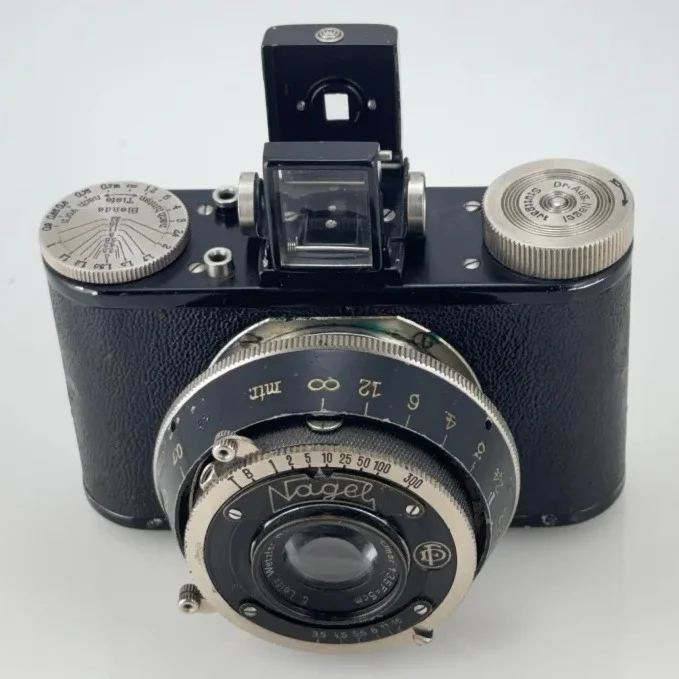
Nagel Pupille , Leitz Elmar 5cm f/3.5 lens
CHF 650.00
The Nagel Pupille is one of the most intriguing sub-miniature-format viewfinder cameras to emerge from the fertile Stuttgart camera industry of the early 1930s. Designed by Dr. August Nagel — who had previously founded Contessa-Nettel and co-founded Zeiss Ikon before establishing his own Nagel-Werk in 1928 — the Pupille was introduced around 1931 and produced until Kodak AG absorbed the Nagel-Werk in 1931 and continued refined production through approximately 1935. The camera exposes 16 × 24 mm frames on standard 35mm film (the so-called "half-frame" format), positioning it as a compact companion to the emerging Leica system rather than a direct competitor.
What distinguishes this particular example from more common Pupille configurations is the presence of a Leitz Elmar 5cm f/3.5 lens — serial number 101403 — in place of the more frequently encountered Schneider Xenon or Leitz Elmar 3.5cm options. The Elmar in Tessar-type four-element construction was the definitive standard optic of the Leica I era, and its fitment here — on a unique helical-extension mount integrated directly into the Compur shutter cell — represents a fascinating collaboration between Leitz Wetzlar and Nagel Stuttgart. The Compur shutter provides a clean speed range of approximately 1 second to 1/300 sec plus B and T, giving the photographer full manual control.
The top plate carries two large milled-wheel dials: the left-hand dial is a depth-of-field / aperture calculator ("Blende / Tiefe"), the right-hand dial is marked "Dr. Aug. Nagel Stuttgart" and serves as the film advance and exposure counter. Between them sits a collapsible optical viewfinder of the direct-vision type, which folds flat for pocketing. The back panel bears the elegant "Pupille" script nameplate flanked by two burgundy red windows — film-counter windows for use with daylight-loading film cartridges. The underside reveals a standard tripod bush and a locking disc marked with "A" and "N" (Aufzug / Nachzug — wind / release interlock).
The ever-ready leather case — dark brown, hand-stitched in white thread — is original to the camera and shaped with the distinctive rounded profile demanded by the Pupille's protruding lens cylinder. Heavy crazing to the front is typical of cases that have seen real field use, and both the buckle fastener and the shoulder strap remain serviceable.
Material: Black lacquered die-cast metal body, fine-grain leatherette covering, nickel-plated brass fittings and dials, brown stitched leather ever-ready case
What distinguishes this particular example from more common Pupille configurations is the presence of a Leitz Elmar 5cm f/3.5 lens — serial number 101403 — in place of the more frequently encountered Schneider Xenon or Leitz Elmar 3.5cm options. The Elmar in Tessar-type four-element construction was the definitive standard optic of the Leica I era, and its fitment here — on a unique helical-extension mount integrated directly into the Compur shutter cell — represents a fascinating collaboration between Leitz Wetzlar and Nagel Stuttgart. The Compur shutter provides a clean speed range of approximately 1 second to 1/300 sec plus B and T, giving the photographer full manual control.
The top plate carries two large milled-wheel dials: the left-hand dial is a depth-of-field / aperture calculator ("Blende / Tiefe"), the right-hand dial is marked "Dr. Aug. Nagel Stuttgart" and serves as the film advance and exposure counter. Between them sits a collapsible optical viewfinder of the direct-vision type, which folds flat for pocketing. The back panel bears the elegant "Pupille" script nameplate flanked by two burgundy red windows — film-counter windows for use with daylight-loading film cartridges. The underside reveals a standard tripod bush and a locking disc marked with "A" and "N" (Aufzug / Nachzug — wind / release interlock).
The ever-ready leather case — dark brown, hand-stitched in white thread — is original to the camera and shaped with the distinctive rounded profile demanded by the Pupille's protruding lens cylinder. Heavy crazing to the front is typical of cases that have seen real field use, and both the buckle fastener and the shoulder strap remain serviceable.
Material: Black lacquered die-cast metal body, fine-grain leatherette covering, nickel-plated brass fittings and dials, brown stitched leather ever-ready case
Condition notes
Overall condition rates VG to VG+. The black lacquer body shows light scuffs and minor corner brassing consistent with honest use over nine decades; no deep dents or cracks noted. The leatherette covering is largely intact and adhered. The top-plate
nagel
nagel pupille
nagel-werk
leitz
elmar
50mm f3.5
compur
half-frame