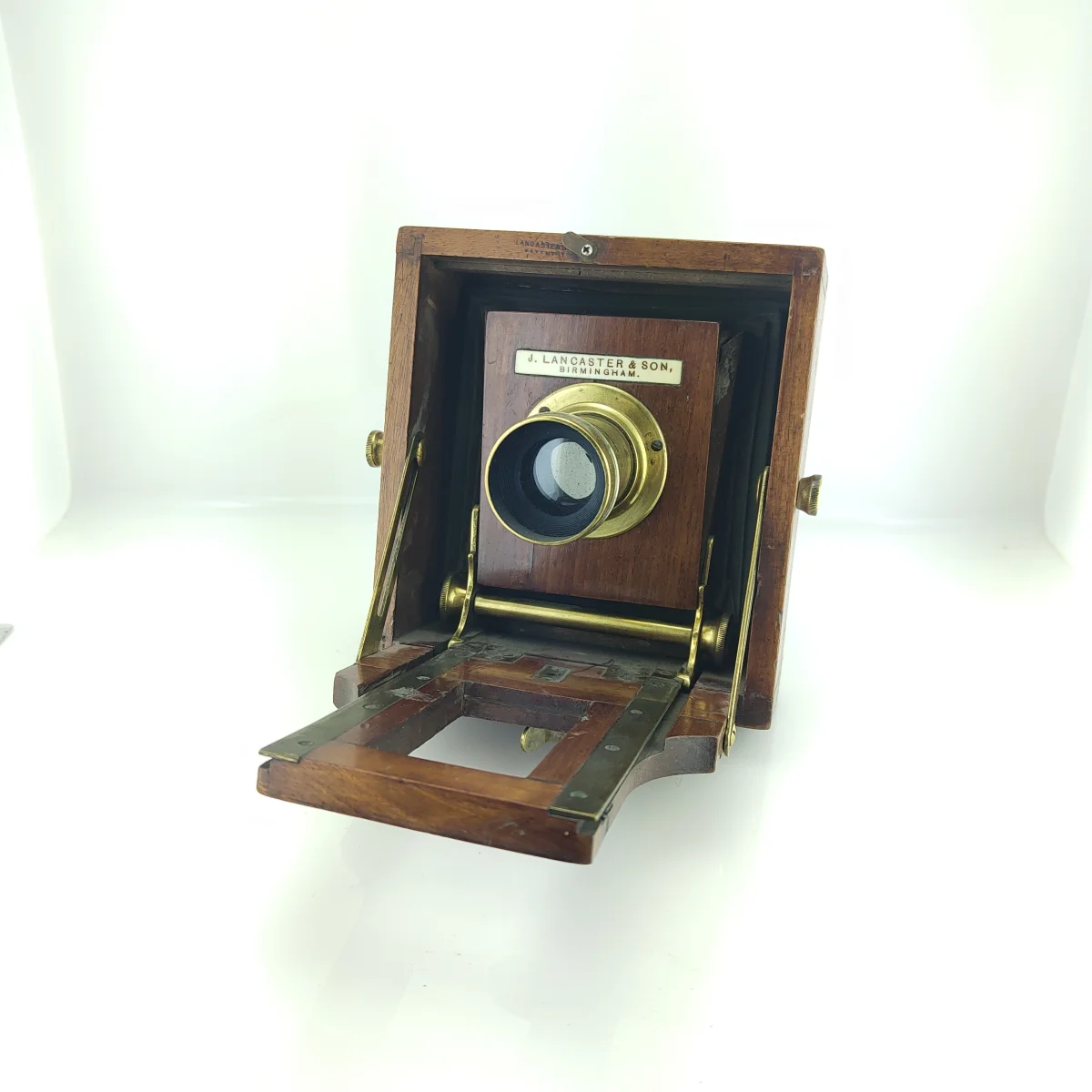
J. Lancaster & Son "Le Merveilleux" Patent Detective Camera, Quarter-Plate, Version 2, ca. 1890–1900
CHF 690.00
The example offered here is a Version 2 (hinged-back) camera in quarter-plate format, exposing plates of approximately 3¼ × 4¼ inches (83 × 108 mm). The absence of "Ltd." in the maker's name on the lensboard tag confirms manufacture prior to 1905; stylistic and constructional details place this example most plausibly in the core production decade of c.1890–1900. The body is constructed from fine-grained mahogany, dovetailed and screwed to produce a rigid, tailboard folding-field form of generous proportions. When closed, the hinged lid — secured by brass clasps and carrying the "Le Merveilleux Patent" celluloid nameplate — gives the camera the appearance of an elegant dispatch box rather than a photographic instrument. Opened for use, the lid drops forward on a pivoting brass strut brace to form a support stand, revealing the internal lens standard and plate-loading chamber. The rear panel is fitted with a ground-glass focusing screen framed in brass corner reinforcements, allowing composition and approximate focus before the sensitised plate is loaded.
The lens is an original Lancaster brass-barrel simple landscape type fitted with a rotary iris/aperture lever — a clean, period-correct optical unit consistent with the camera's detective designation. No separate shutter is present in this example; the camera was either operated by lens-cap, or the shutter mechanism (of the kidney-bean, see-saw, or rubber-band rotary type commonly associated with this model) has been lost. This distinction has a modest but real bearing on usability and, to a lesser degree, on collector value. Three original maker's markings survive: the celluloid lid tag ("Le 'Merveilleux' Patent"), the celluloid lensboard tag ("J. Lancaster & Son, Birmingham"), and an internal wood stamp ("LANCASTER PATENT") near the rear rail — a combination that leaves no doubt as to authenticity and originality.
One important caveat: the condition of the bellows has not been confirmed from the available photographs, and an extended rear-to-front shot is recommended before final pricing or sale. If the bellows are present and substantially light-tight, the camera falls comfortably within the upper tier of the quarter-plate V2 market corridor. A missing or deteriorated bellows would reduce value by approximately 30%.
Cameras of this pattern were sold to gentlemen amateurs, press photographers, and early photographic enthusiasts across Britain and the Empire throughout the late 1880s and 1890s, bridging the gulf between the large-format studio outfit and the snapshot hand cameras that proliferated after Eastman's Kodak revolution of 1888. Directly comparable examples — quarter-plate, both tags intact, honest condition — have realised €396–€432 including buyer's premium at Leitz Photographica auctions. Surviving examples retaining original lens, intact ground glass, all brass furniture, and both maker's tags in legible condition are genuinely uncommon; the additional presence of the internal wood stamp makes this a particularly well-documented and desirable cabinet piece or collection centrepiece.
Material: Polished mahogany body with dovetailed and screwed construction; polished brass hinges, corner protectors, clasps, strut brace arm, focus knobs, and lens barrel; ground-glass focusing screen framed in brass corner reinforcements; internal black-painted chamber lining
Condition notes
Overall condition is very good for its age — approximately VG+ on the collector scale. The mahogany body displays honest age patina: scattered light surface scratches, minor grain-lifting on the side panels, and a few small surface losses on the wood at corners, none of which compromise structural integrity. All brass hinges on the top lid and side panels function correctly and remain tight; the brass clasps engage cleanly. The polished brass lens barrel retains attractive original patina throughout — no pitting or corrosion visible. The ground-glass focusing screen at the rear is present and fully intact, showing no cracks; the brass corner reinforcements framing it are secure. The fold-out baseboard and brass strut-brace mechanism operates as intended, locking the front panel at the correct angle. All brass hardware including focus knobs is present and functional. Both celluloid maker's tags are present and fully legible: the lid tag reading "Le 'Merveilleux' Patent" and the lensboard tag reading "J. Lancaster & Son, Birmingham." An internal wood stamp reading "LANCASTER PATENT" is present near the rear rail. Note: bellows state has not been confirmed from available images — a rear-to-front extended shot is needed to verify presence and light-tightness; this remains the single most significant price-swing variable. No plate holder (DDS) is included. No separate shutter is present — the camera was either operated by lens-cap or the shutter has been lost.