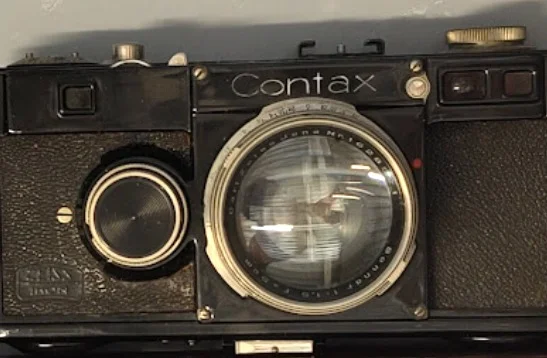
Contax I (a) Black-Dial Rangefinder Camera, ca. 1933–36, with Sonnar 5 cm f/2
CHF 950.00
The Contax I marked Zeiss Ikon's direct challenge to Leica's dominance in the professional 35 mm market. Announced in 1932 and refined through several iterations until 1936, the Contax I introduced innovations that would influence rangefinder design for decades: a coupled rangefinder with longer effective base length than the Leica II (improving focusing accuracy), interchangeable lenses via a sophisticated bayonet mount, and a vertically travelling metal focal-plane shutter offering speeds from 1/25 to 1/1000 second.
This example is an early 'a' variant, identifiable by the black-painted rangefinder dial visible through the viewfinder window — a feature replaced by bright-line frames in later versions. The body is finished in black lacquer over brass, now showing attractive natural brassing around high-wear areas: rangefinder windows, advance knob, and top-plate edges. The vulcanite covering remains complete with only minor handling marks.
The lens is a Carl Zeiss Jena Sonnar 5 cm (50 mm) f/2 in chrome mount — a landmark optical design by Ludwig Bertele that delivered exceptional sharpness and contrast, making it the preferred choice of photojournalists and serious amateurs throughout the 1930s. The Sonnar formula (typically 7 elements in 3 groups) minimised internal reflections in an era before multi-coating. This example shows internal haze consistent with age but no fungus or element separation; optical performance would benefit from professional cleaning.
Mechanical condition: The shutter releases and fires across the speed range, though actual speeds have not been calibrated and may vary. The rangefinder patch is visible and coupling appears functional, but focusing accuracy should be verified and adjusted as needed. Film advance operates smoothly. The accessory shoe is present and undamaged.
Historical context: Pre-war Contax cameras are considerably rarer than Leicas of the same period, as Dresden production was disrupted by WWII and the subsequent Soviet occupation. Many surviving examples were war-damaged or dismantled for parts. Postwar, the Contax name was split between East (Zeiss Ikon VEB) and West (Zeiss Ikon Stuttgart), making the pre-1945 Dresden cameras particularly significant to collectors.
This camera represents an important chapter in photographic history — the moment when Zeiss, already legendary for its optics, entered the 35 mm system camera market with uncompromising German engineering. Ideal for the collector seeking an early Contax I in honest, displayable condition or the repairer willing to return this landmark camera to full working order.
Material: Black lacquered brass body, chrome-plated brass trim, vulcanite covering
This example is an early 'a' variant, identifiable by the black-painted rangefinder dial visible through the viewfinder window — a feature replaced by bright-line frames in later versions. The body is finished in black lacquer over brass, now showing attractive natural brassing around high-wear areas: rangefinder windows, advance knob, and top-plate edges. The vulcanite covering remains complete with only minor handling marks.
The lens is a Carl Zeiss Jena Sonnar 5 cm (50 mm) f/2 in chrome mount — a landmark optical design by Ludwig Bertele that delivered exceptional sharpness and contrast, making it the preferred choice of photojournalists and serious amateurs throughout the 1930s. The Sonnar formula (typically 7 elements in 3 groups) minimised internal reflections in an era before multi-coating. This example shows internal haze consistent with age but no fungus or element separation; optical performance would benefit from professional cleaning.
Mechanical condition: The shutter releases and fires across the speed range, though actual speeds have not been calibrated and may vary. The rangefinder patch is visible and coupling appears functional, but focusing accuracy should be verified and adjusted as needed. Film advance operates smoothly. The accessory shoe is present and undamaged.
Historical context: Pre-war Contax cameras are considerably rarer than Leicas of the same period, as Dresden production was disrupted by WWII and the subsequent Soviet occupation. Many surviving examples were war-damaged or dismantled for parts. Postwar, the Contax name was split between East (Zeiss Ikon VEB) and West (Zeiss Ikon Stuttgart), making the pre-1945 Dresden cameras particularly significant to collectors.
This camera represents an important chapter in photographic history — the moment when Zeiss, already legendary for its optics, entered the 35 mm system camera market with uncompromising German engineering. Ideal for the collector seeking an early Contax I in honest, displayable condition or the repairer willing to return this landmark camera to full working order.
Material: Black lacquered brass body, chrome-plated brass trim, vulcanite covering
Condition notes
Good (G). Body shows honest wear consistent with age: brassing to edges and high points, particularly around the rangefinder windows and top-plate corners. Chrome lens mount retains most original finish. Vulcanite intact with minor compression marks. Viewfinder windows show internal dust/haze — typical for pre-war Contax. Shutter fires but speeds not verified; rangefinder coupling appears functional but accuracy unknown. Lens glass displays moderate internal haze consistent with 85+ years, no separation or fungus visible. A solid user-grade example of the earliest Contax variant.
contax i
contax ia
zeiss ikon
dresden
1930s camera
pre-war contax
black dial contax
sonnar 50mm f/2