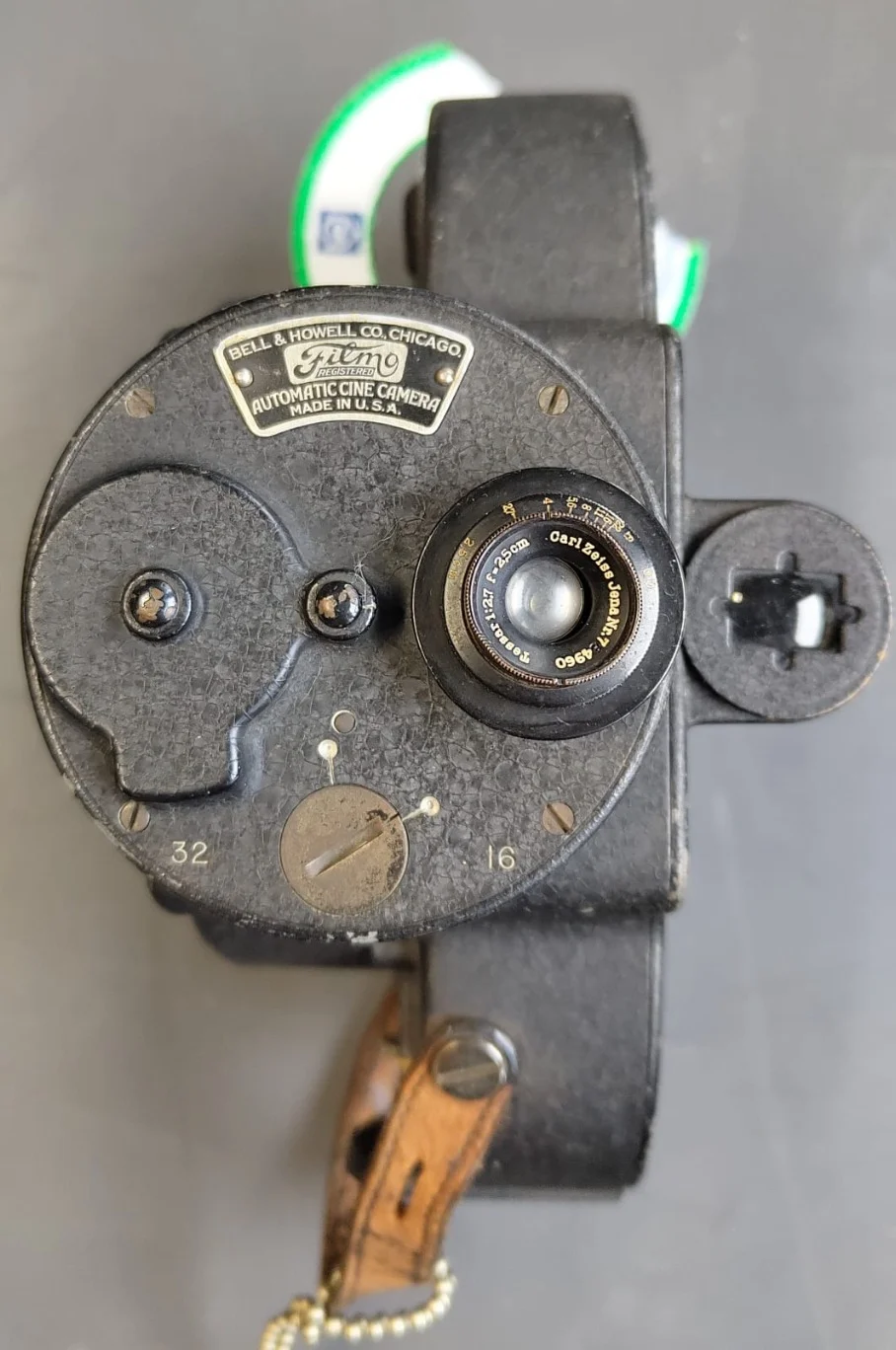
Bell & Howell Filmo 70-A 16mm Cine Camera — Carl Zeiss Jena Tessar 25mm f/2.7, ca. 1925–29
CHF 550.00
The front nameplate reads in full: "BELL & HOWELL CO., CHICAGO — Filmo REGISTERED — AUTOMATIC CINE CAMERA — MADE IN U.S.A." The rear panel carries the earlier shield emblem, "STANDARD BELL & HOWELL COMPANY CINEMACHINERY," a designation phased out on later production runs and a reliable indicator of this camera's early manufacture. Two frame-rate positions — 16 and 32 fps — are selected via the rotary dial on the operator's face; the footage counter dial, graduated to 100 ft, is visible on the top of the camera body. Two film-chamber door latches (marked OPEN/CLOSED) are present on the loading side, both appearing intact and functional. The spring-motor winding key is attached on a ball chain with a period leather fob, keeping it conveniently at hand.
What distinguishes this body above all is its optic: a Carl Zeiss Jena Kino-Tessar f/2.7, F=2.5cm, serial number 4960 (list number 7 as engraved on the ring). The four-element Tessar formula — Zeiss's celebrated "eagle eye" — was specified in this fast f/2.7 cine variant for Zeiss's own Kinamo and Movikon 16mm cameras of the same decade. American Filmo bodies were conventionally supplied with Cooke Anastigmat or Wollensak Velostigmat lenses; the presence of a factory- or period-installed Carl Zeiss Jena optic makes this a dual-interest piece for both cine-camera historians and Zeiss glass collectors alike.
Condition is consistent with a century of working life: the crinkle-lacquer finish shows honest surface oxidation and light crazing across the main disc and body panels, with some scattered spotting to the rear housing visible under raking light. The original brown leather carrying strap survives, aged and darkened but structurally sound. The winding key and chain are present and original in appearance. The two film-door latches operate correctly and the fps selector moves between positions. The Tessar glass appears free of fungus in the images; precise assessment of internal haze would require bench inspection, but the front element photographs cleanly. Mechanical function — spring-wind, governor, shutter — is described by the consignor as operational.
Material: Die-cast aluminium body with crinkle-lacquer black finish; nickel-plated hardware; brass lens mount ring; aged brown leather carrying strap; steel winding key on ball chain
Condition notes
Overall VG condition for a camera of this age. The crinkle-lacquer finish displays honest surface oxidation, light crazing, and scattered oxidation spotting — most pronounced on the rear housing panel — consistent with approximately 95 years of use and storage. No deep dents or structural damage visible. The fps selector dial and film-door latches appear intact and operable. The original leather strap has darkened and stiffened with age but remains structurally attached. The winding key and ball chain are present. The Tessar front element photographs cleanly with no evident fungus bloom; internal haze cannot be definitively ruled out without bench inspection. Mechanical operation (spring-wind, governor, shutter) reported by consignor as functional.