Antique Italian Reliquary Medallion — Saint Guido of Acqui, ca. 1860–1920
CHF 180.00
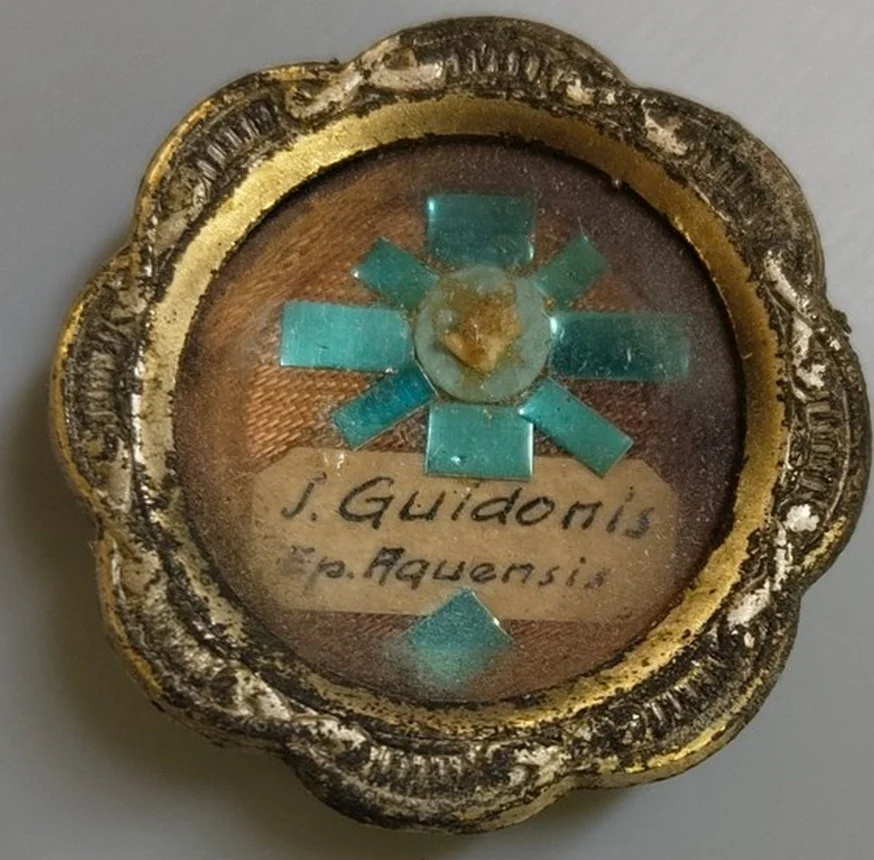
A finely worked Italian reliquary medallion (Reliquienmedaillon / pendant theca) of the later 19th or early 20th century, preserving a relic fragment attributed to Saint Guido of Acqui (ca. 1004–1070), Bishop of Acqui and principal patron of that north-Italian diocese. The hand-inscribed cedula reads in Latin abbreviation "S. Guidonis / Ep. Aquensis" — Sancti Guidonis, Episcopi Aquensis, "of Saint Guido, Bishop of Acqui."
Description
Small round devotional pendant with a scalloped cast rim in fire- or mercury-gilt brass / bronze, now with broad honest wear revealing the underlying base metal. Under a slightly domed glass cover, a velvet-brown silk ground carries a stylised cross assembled from turquoise-green metal-foil paillettes, in the tradition of Klosterarbeit — convent work, a decorative technique developed in European nunneries from the 17th century for the artistic framing of body relics. At the centre of the cross sits the relic particle itself, likely a first-class relic (ex ossibus — a bone fragment) secured under a small wax or glass seal. A hand-written paper cedula with the saint's name is applied below the cross. The upper suspension loop is intact; the piece was made to be worn.
Saint Guido of Acqui
Guido (also Wido, Guy, Guisto; ca. 1004 – 2 June 1070) was Bishop of Acqui in Piedmont, northern Italy, from 1034 until his death. He built the cathedral of Santa Maria Assunta, consecrated in 1067, where his relics remain today. His cult was formally confirmed (confirmatio cultus) by Pope Pius IX in 1853 — the plausible terminus post quem for wider distribution of relic particles bearing his name, and consistent with the dating of the present medallion.
Condition — honest disclosure
Good, age-appropriate condition. The gilding is broadly rubbed; the pallet cross and cedula are fully preserved; the viewing glass is clear; the silk backing shows age-related toning; the suspension loop is intact.
Please note: the piece retains no original wax seal on the reverse (typically a red sealing-wax impression bearing the arms of the authorising bishop), nor is an accompanying authentica document present. Church-canonical authentication is therefore not formally documented. The medallion is offered as an antique devotional object of historical and decorative interest; attribution of the relic content rests on the hand-written cedula alone.
Specifications
Diameter approx. 25–30 mm · Period: second half 19th – early 20th century · Origin: Italy, probably Piedmont (Diocese of Acqui) · Materials: gilt brass / bronze, glass, silk, metal-foil paillettes, paper (cedula) · Type: reliquary medallion (pendant reliquary, theca)
A fully researched catalogue entry (PDF, with photographs and sources) is available
Description
Small round devotional pendant with a scalloped cast rim in fire- or mercury-gilt brass / bronze, now with broad honest wear revealing the underlying base metal. Under a slightly domed glass cover, a velvet-brown silk ground carries a stylised cross assembled from turquoise-green metal-foil paillettes, in the tradition of Klosterarbeit — convent work, a decorative technique developed in European nunneries from the 17th century for the artistic framing of body relics. At the centre of the cross sits the relic particle itself, likely a first-class relic (ex ossibus — a bone fragment) secured under a small wax or glass seal. A hand-written paper cedula with the saint's name is applied below the cross. The upper suspension loop is intact; the piece was made to be worn.
Saint Guido of Acqui
Guido (also Wido, Guy, Guisto; ca. 1004 – 2 June 1070) was Bishop of Acqui in Piedmont, northern Italy, from 1034 until his death. He built the cathedral of Santa Maria Assunta, consecrated in 1067, where his relics remain today. His cult was formally confirmed (confirmatio cultus) by Pope Pius IX in 1853 — the plausible terminus post quem for wider distribution of relic particles bearing his name, and consistent with the dating of the present medallion.
Condition — honest disclosure
Good, age-appropriate condition. The gilding is broadly rubbed; the pallet cross and cedula are fully preserved; the viewing glass is clear; the silk backing shows age-related toning; the suspension loop is intact.
Please note: the piece retains no original wax seal on the reverse (typically a red sealing-wax impression bearing the arms of the authorising bishop), nor is an accompanying authentica document present. Church-canonical authentication is therefore not formally documented. The medallion is offered as an antique devotional object of historical and decorative interest; attribution of the relic content rests on the hand-written cedula alone.
Specifications
Diameter approx. 25–30 mm · Period: second half 19th – early 20th century · Origin: Italy, probably Piedmont (Diocese of Acqui) · Materials: gilt brass / bronze, glass, silk, metal-foil paillettes, paper (cedula) · Type: reliquary medallion (pendant reliquary, theca)
A fully researched catalogue entry (PDF, with photographs and sources) is available